• Home
  • Books
  • Bio
  • The Series
  • News
  • Media Room
  • Mailing List
  • Contact

L.J. Wilson

Author of Ruby Ink

JOIN THE MAILING LIST
Follow L. J. on FacebookFollow L. J. on TwitterFollow L. J. on PinterestFollow L. J. on Google+Follow L. J. on GoodreadsFollow L. J. on Instagram
Follow Us on FacebookFollow Us on Google+Follow Us on TwitterFollow Us on PinterestFollow Us on RSSFollow Us on GoodreadsFollow Us on Instagram
AB Edge
(2016-05-17)

Buy the Book

Amazon

Buy the eBook

Kindle
Nook
iBooks
Kobo

Recent Posts

  • How to Post Your Novel Status on Facebook
  • Seriously? She Writes Romance?
  • Big Author Goals, Medium on the Side
  • Hot Off the Press!
  • Catching the Ghostwriter

Recent Comments

  • Online SEL Kindergarten Grade Program on Oh, the Drama!
  • https://rostovfeya2.net/ on Oh, the Drama!
  • link slot online on Oh, the Drama!
  • slot deposit 10k on Oh, the Drama!
  • биткойн инвестиции on Oh, the Drama!

Archives

Is a Pen Name a Good Thing?

March 15, 2015 by L. J. Wilson 1 Comment

SONY DSCA blend of folklore and fact explains how Samuel Clemmons became Mark Twain, another byproduct of the famed author’s time as a riverboat employee. The most validated tale revolves around captain Isaiah Sellers and his pragmatic descriptions of the Mississippi River—its water levels and favorable, or not, sailing conditions. In the margin of his logs, it’s said that Sellers embellished the dry waterway notes, detailing the river with more interesting and less perfunctory information. He’d sign his all his findings—exaggerated and unadorned—“Mark Twain.” And so was born the identity that Samuel Clemmons chose for his own writing. The words he saw as extensions of the truth, or the fiction we know as Tom Sawyer and Huckleberry Finn.

Fast-forward a century and a half, to J. K. Rowling, who chooses her pen name based on a business hunch. Would pre-teen and teenage boys (her intended audience for the yet to be published Harry Potter) respond favorably to a woman’s name (Joanne) on the book’s cover? Well, in addition to a great story, it certainly didn’t seem to hurt.

Between Twain and Rowling, countless authors have chosen pen names for a variety of reasons—some gender bending, others to protect their privacy, ease of use if their given name were nearly unpronounceable, or to avoid confusion. Should you have suffered the curious luck of being born Stephen King or Margaret Mitchell, and decide, you too, were a writer, separating yourself from these greats would be a no-brainer. If not, be prepared. Any and all comparisons are guaranteed literary suicide.

With the dizzying metamorphosis of publishing, authors have turned the pen name page again. A pseudonym, along with the aforementioned uses, also signals a shift in genre—something more and more authors are embracing. Rebranding is how trendsetters and even traditional publishing houses refer to it, and L. J. Wilson is my own example. After publishing two women’s fiction novels, the idea sprouted to do something… shall we say, tastefully risqué. Not long into the first draft, it became apparent that if I wanted to write sensual romance, if I wanted to properly brand myself and the Clairmont series, a pen name was paramount.

I tried on names like dresses in a fitting room—you just know what’s a keeper and what to toss aside. I thought about pseudonyms that might resonate with readers, wondering what would do more harm than good. In the end, I went with something that was a natural fit, choosing my maiden name and initials. Because I’m so pleased with Ruby Ink, and having developed such a fondness for the Clairmont stories, I was fine with closely associating, and hardly hiding the fact that L. J. Wilson and Laura Spinella are the same person.

Is it necessary? Will the trend continue? Could Laura Spinella have just as easily written Ruby Ink? Opinions will vary, and like everything else in publishing, no one knows for sure. But I suspect there’s a good chance J. K. & Robert Galbraith would agree with that much.
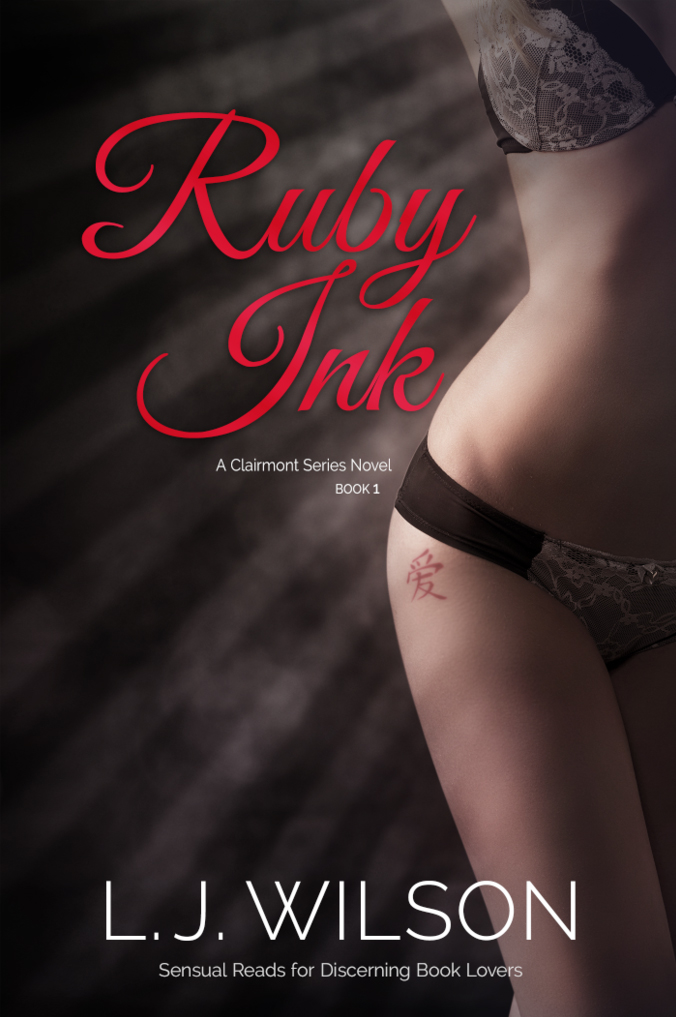

ruby-in-cvr

While you’re here, enter to win a $100 Amazon Gift Card, celebrating Ruby Ink’s release, and don’t miss the Goodreads giveaway. I’m giving away 7 signed copies of Ruby Ink.
“A sultry story… intensely emotional and full of heart. L. J. Wilson is a discovery.”
—Shannon McKenna, New York Times bestselling author
Photo courtesy of gratisography.com

Filed Under: Blog, Writing Tagged With: L. J. Wilson, Laura Spinella, novel, romance, Ruby Ink

Oh, the Drama!

March 8, 2015 by L. J. Wilson 7 Comments

couple-278269_1280Writers—romance writers in particular—require drama. I mean, if it weren’t for conflict, books would be rather boring things. In real life it’s not so black and white, as no one likes endless jags of drama, fits of jealousy or continuous battle rounds—unless it’s The Voice. Still, whether drama is found in your living room or a novel, occasional emotional anarchy is unavoidable.

A recent Washington Post article put the topic of personal drama under a microscope, dissecting and classifying the scientific explanation of human turmoil, especially when it comes to couples: “During times of stress, the hormones cortisol (which makes us feel anxious) and oxytocin (which prompts feelings of love and nurturing) are released into the bloodstream. Men, however, produce lower amounts of oxytocin than women. As a result, men tend to respond to stress by becoming angrier and more aggressive.”

The article goes on to note that men often use the accusation of drama to end an argument, thereby watering down their significant other’s complaint.

It explains a lot regarding this specific human condition, as well as facilitating the scope of emotions available to the characters writers’ create.

As noted, I write romance—so I do a lot of thinking about how men and women react to drama: arguments, feelings of jealousy and even rage. Overall, the Washington Post article mirrored my general rule of thumb when expressing how men and women interact—particularly characters whose heartfelt emotions might overrule their intellectual response. To dumb it down, boys do it differently than girls.

A good example can be found in my upcoming novel, Ruby Ink—yes, even a romance novel can further the insights of the Washington Post. The scene I’m thinking of centers on the hero and heroine, who are reunited after a pain-filled seven-year separation. During that time, each character had to deal with the emotional aspects of the estrangement. By the time we get them in a room, the reader, Ruby and Aaron are primed for conflict, not to mention a healthy slathering of drama. As the fly on the wall that makes it all go, my job is to craft reactions that ring true to life, and even the Washington Post.

As the scene unfolds, Aaron is aggressive—and I don’t mean aggressive in a violent way. Remember, this is romance, so I have leeway in terms of how he reacts to being alone with Ruby—a woman he’s hopelessly in love with and that Aaron had never expected to see again. Ruby, on the other hand, approaches the moment from the opposite end of the drama meter. She pleads her case verbally, although emotion is clearly driving her thoughts, both dialogue and physical cues.

The tension builds as Ruby’s emotions begin to spill over, heightening the drama and hopefully encouraging the reader to turn the page. But as the scene concludes with the interruption of a third party, I’m brought back around to the reality of the Washington Post article.

In the end, it’s Aaron who can’t flesh out what he’s feeling or how he should respond to Ruby’s sudden presence. The scene fades to black, leaving a sea of unsettled emotion, and our hero feeling rather angry, almost stunted in his reply—hence that lack of oxytocin. For Ruby, it’s the opposite result. The return of her hero has opened a floodgate of emotion that is clear to herself and the reader. Throughout a novel, whether it’s the main characters or minor players, the writer must be conscious of nature’s natural order—or allocation of hormones as the case may be.

Want to discover the story behind Aaron and Ruby’s seven-year separation—what tore them apart and the incredible circumstance that brings them together? Pre-order Ruby Ink, on sale March 31st!RUBY-FinalCover


While you’re here, enter to win a $100 Amazon Gift Card, celebrating Ruby Ink’s release, and don’t miss the Goodreads giveaway. I’m giving away 7 signed copies of Ruby Ink.

“A sultry story… intensely emotional and full of heart. L. J. Wilson is a discovery.”—Shannon McKenna, New York Times bestselling author

picture courtesy of pixabay

Filed Under: Blog Tagged With: characters, conflict, drama, emotions, L. J. Wilson, Laura Spinella, novel, Ruby Ink, Washington Post

Copyright © 2026 L.J. Wilson