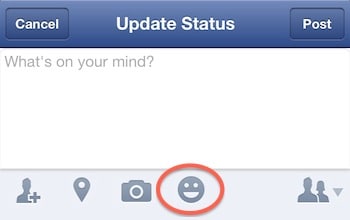
 For what seems like stationary thing, status is a busy word. It can tell you something simple, like the “in transit” location of the cat tree you ordered on Amazon. Traditionally, the word status speaks to one’s life achievements. Nowadays, status is most commonly associated with Facebook vernacular. The other day, because my brain hit a wall, (not so strange) I thought: What if you could capture a novel’s progress in terms of a Facebook status? Would it look something like this?
To Send a Friend Request: This is where you and your novel idea meet—maybe it’s in a bar, maybe it’s at the dry cleaner. But it starts with a casual glance, an idea that seems… appealing. The next thing you know you’re trolling Facebook, searching names. It has to be the right name. (Hopefully you haven’t met John Smith, because Facebook is a big place and you could literally spend days searching for your particular John Smith) In the case of a book, you’ll likely settle on a few names for your burgeoning characters. You might change them along the way; you might not. Names are a highly personal choice for the author. But I’ve noticed this about novel names: Alice, Emma, Sarah, or Ann is far more likely to show up as a female protagonist than Helga, Irene, Rita or Gladys. Interestingly, I couldn’t draw the same conclusion about the names of male characters.
Let’s assume your book accepts your friend request and the two of you are …
In a Relationship: Things begin to happen. In terms of a book, this means your plot is brewing. Like any relationship, and if you’re wise, there is a reasonable getting to know you period. This is where you figure out if you and your book have any chance at a future. It starts out like wildfire—there’s chemistry. It’s hot and sexy—though not necessarily sexual—and a page-turner. You don’t want to do anything but be with this book. You barely have to make an effort and things happen. It’s magic.
Then around page fifty (the three-month mark for human relationships) you hit a snag.
Suddenly this book has a few bad habits that are hard to overlook. Instead of pages on fire, you’re holding a book of wet matches. It all seems so confusing and frustrating and, quite  frankly, pointless to continue. The characters you thought you’d fallen in love with don’t appear exactly as advertised. There’s a fight and you almost give up. You yell. You may throw things. You are ugly to the people you live with. You consider changing your Facebook status to separated, maybe even back to single.
To hell with this stupid book.
But then you notice all your mutual friends on Facebook. There are expectations—you’ve posted things about this book relationship. People will notice. You’ll have to explain. Worse, you’ll have to start over. Haplessly… begrudgingly, you trudge forward. And then, damn. Before you know it, you have more than one hundred pages. You and your book have made up. It doesn’t send flowers because, hell, it’s a book—but it does manage to deliver that killer line, at precisely the right moment. You can see a real future with this book and that’s called…
Engaged: This is the day real people post all kinds of sparkly happy shit on Facebook. This might be where writers post: Plunging with hopeful speed toward the last chapter! Ready the champagne! Pray for me! Human counterparts show off surprisingly manicured ring finger close-ups, bearing brilliant diamonds. Maybe it’s tasteful; maybe it’s so big that your Facebook friends secretly message each other saying, “OMG, did you see that post? She just wants to so totally shove it in everyone’s face.”
Either way, as far as you and your book are concerned, this is a sure thing—for better or worse, you are destined to finish this novel and you do. But before long…
 It’s Complicated: You thought you had it. You thought this book screamed, “You complete me…” Then the outside world barges in—what did you expect? This is social media. Everyone will have an opinion. When it comes to your book, this might be your agent or editor. “It’s really very good,” they say. “But just think what would happen if…” You want to cry and shriek and break up all over again—maybe with your agent or editor, but mostly with your book. You don’t want to take it apart and start again. It’s too hard. Dear God, at this point, becoming an astrophysicist would be an easier feat. So you sulk and don’t look at any kind of book for days, maybe a week. You consider deleting the entire thing. But before long, the temptation is too much and you find yourself…
Married: This is code for On Sale Now in the world of books. And for a time, everything is bright and shiny and wonderful. It’s only after the honeymoon stage that you realize this is work. Like a marriage, your book requires your loyal dedication and serious commitment if you want it to succeed. Still, things may be so wonderful that on anniversaries you post one of those Facebook status updates about how lucky you are to have married your “best friend.” Translation: “I wrote a bestseller, and, man, am I damn lucky I stepped in it.”
 If we met at a party, on an airplane, or got stuck in an elevator, then were asked “Can you tell me something about L. J. Wilson?” the last thing you’d answer is “She writes romance.” Sarcastic, wine drinker, cat person, lover of Georgia football (woohoo, Georgia fan!) and inappropriate humor, any of those would be a solid guess—and you’d be right. I don’t wear romance writer on my sleeve and I tend to roll my eyes at rom-coms. I never got Jane Austen. I am a poor representative of my romantic writing peers.
 I live an old house. It makes sense: writer, vintage property, high on a hill, seclusion. If the liquor store delivered, I’d never leave. Atmosphere is never in short supply, the house adapting to seasons like a clapboard chameleon. I connected to this house the second I saw it, even after confronted by a kitchen that looked like something the Property Brothers would reject. In its favor was a to-die-for sunroom and built-in character, the kind modern homes can’t possibly produce.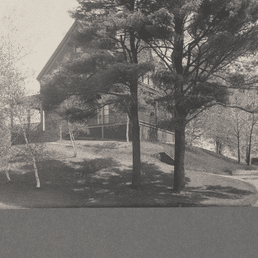
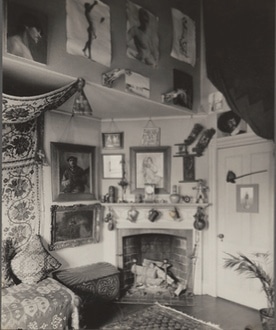 But at a glance, much of the square footage didn’t make sense, neither did the grandeur. The rooms in these photos were dressed like a manor home, not my period Arts & Crafts abode. It was confounding, but eventually I realized how architectural changes aligned with long-ago photos. This was my house, inside and out. But who were the Rathbuns—a name I’d never heard of? It took some digging to unearth the family, in particular Anna Rathbun. She was a highly accomplished woman for her era and this one. A graduate of Wellesley College, she was schooled in the fine arts, furthering her artistic pursuits in Paris. Apparently, she brought her passion for all art forms into our house, which turned out to be a summer home for the well-to-do Rathbuns of Providence.
 “There are a thousand steps…” It’s my favorite line from my favorite movie. It’s a malleable multipurpose phrase, great for teenagers prepping for SATs and works well with husbands asked to purge garages filled with 15 years of junk. Excuse me, valuable odds and ends, for which a purpose may be imminent.